If you've ever heard a front end clicking in a parking lot and wondered what is a cv axle on a car, here's the plain answer: it's the shaft that sends engine torque to the wheel while the suspension and steering move around it. On front-wheel-drive and many AWD vehicles, that shaft does two jobs at once, and it does them through constant velocity joints packed with grease inside rubber boots. When the boot splits or the joint wears, the noise usually shows up first on turns and under load. I see it a lot on high-mileage Subarus, CR-Vs, Rogues, and lifted SUVs that have been fed a winter diet of salt and potholes.
What the axle is actually doing
The outer joint lives near the wheel and takes the sharpest angle every time you turn into a driveway or crank the steering lock in a parking lot. The inner joint lives closer to the transmission or differential and lets the shaft change length as the suspension moves up and down. That sliding action is why a CV axle can keep power flowing smoothly where an old U-joint setup would start binding and complaining. If the axle is healthy, you do not think about it. That is the goal. You should not hear it, feel it, or see grease sprayed all over the inside of the wheel well. Once dirt gets past the boot, the polished tracks inside the joint wear like a skate blade with a nick in it: the motion still works, but it stops feeling clean.
The clues I trust in the shop
When a customer asks what is a cv axle on a car, I tell them to listen before they spend money. A dry outer joint usually clicks on full-lock turns, especially backing up or circling a lot slowly. A torn boot throws grease onto the control arm, the strut, the inside of the wheel, or the subframe. A worn inner joint usually does not click much at all; it gives you a shake or shudder when you get on the throttle. I checked. If the noise gets louder as you steer and fades when you straighten the wheel, the outer joint is usually guilty. If the problem shows up under acceleration and disappears the second you lift, I start looking at the inner joint, the mounts, and sometimes the transmission side of the equation.
In the bay, I lift the vehicle, grab the shaft near both joints, and rotate the hub by hand. I am looking for roughness, looseness, or a dry snap that should not be there. I also inspect the axle nut history, because a loose nut or a bad previous installation can hurt a bearing and make a good axle sound terrible. On a lot of trucks and SUVs, the axle nut is somewhere in the 150 to 250 lb-ft range, but I still go by the factory spec for that exact model. The bolt doesn't lie, and neither does fresh grease sprayed across the underside of a car.

What it costs before it turns into a bigger job
If you're still asking what is a cv axle on a car, think of it as one of those parts that is cheap when caught early and annoying when ignored. A complete aftermarket axle often runs about $80 to $250, while an OEM unit can land anywhere from $250 to $600 or more, depending on the vehicle. Labor on a straightforward front axle job might be $150 to $350 per side. Once rust, seized hubs, or a broken axle nut show up, the total can climb into the $500 to $900 zone fast. That is still less painful than buying a wheel bearing, tires, and another alignment because the original noise got ignored for six months.
I do not love the cheapest remanufactured axle for a lifted rig or a truck running oversized tires. The angles are steeper, the joint works harder, and bargain parts show their age faster. For a stock-height daily driver, a decent aftermarket unit from a known supplier can make sense. Dorman and Cardone show up a lot in the market, and GKN is a name you will see around OE-level applications. For a family SUV with 120,000 miles, I would rather install one good axle once than save forty bucks and see the same car back on my lift in three weeks.
The bad guess that wastes money
A lot of drivers hear a front-end noise and immediately buy hubs, tires, or sway bar links because those parts get blamed on the internet. That is how money gets burned. A wheel bearing usually gets louder with speed and changes little with steering angle. A tire balance issue shows up in a narrow speed band. A CV joint has a pattern you can reproduce in a parking lot with the wheel turned hard and the window down. That is why the diagnosis matters more than the part number.
I had a Subaru come in with a vibration on acceleration and a click in tight turns. Another shop had already quoted a hub and an alignment. The hub was fine. The outer boot had split on the backside where nobody bothered to look, the grease was gone, and the joint had started to pit. We replaced the axle, torqued the nut to spec, and took it on a long road test. Quiet. No drama. No mystery. That is the kind of repair I like: boring after the fix, obvious before it.
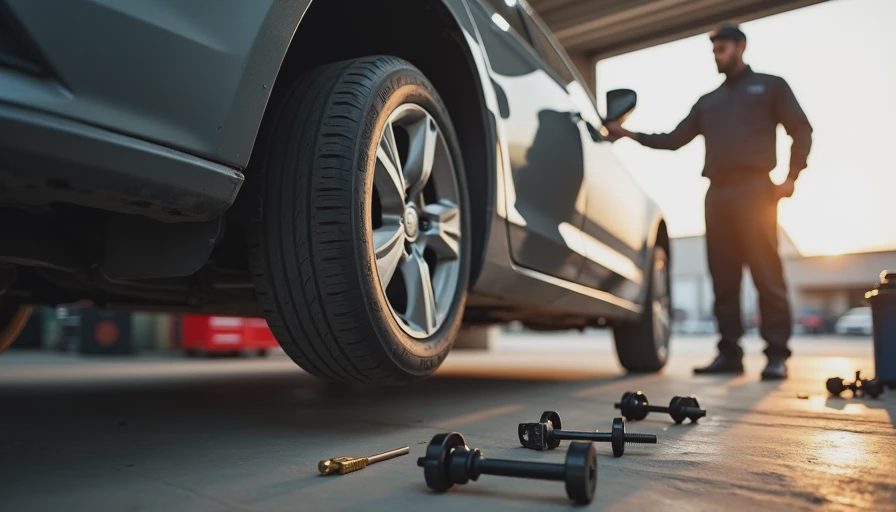
One side or both?
A worn axle does not always mean both sides are bad, but age and mileage matter. If one side failed at 140,000 miles and the other boot is cracked, I am not going to pretend that the opposite side is immortal. I inspect both. If the other axle is dry, tight, and clean, I leave it alone and tell the owner what to watch for. If it is starting to sling grease or make noise on turns, I do both while the labor is already paid for. That is the smarter bill, especially on AWD cars where access can be annoying and the second job is easier to do while the tools are already out.
Lifted SUVs and trucks need even more judgment. A two-inch lift and 33-inch tires can shorten axle life because the joint runs at a worse angle every mile. You do not need a panic rebuild just because a vehicle is modified, but you do need honest inspection intervals. If the boot is torn and the grease is gone, the joint is already counting down. At that point, waiting for a louder noise is just paying extra for the same repair.
The simple answer to what is a cv axle on a car is this: it is the jointed shaft that lets power reach the wheel while the steering and suspension keep moving. When it is right, you never notice it. When it starts failing, it gives you a click, a shudder, or a grease trail that tells the truth. If your SUV is making that sound in a parking lot, get it looked at before the shaft takes the rest of the weekend with it. The bolt doesn't lie.



No letters yet — pray write the first.