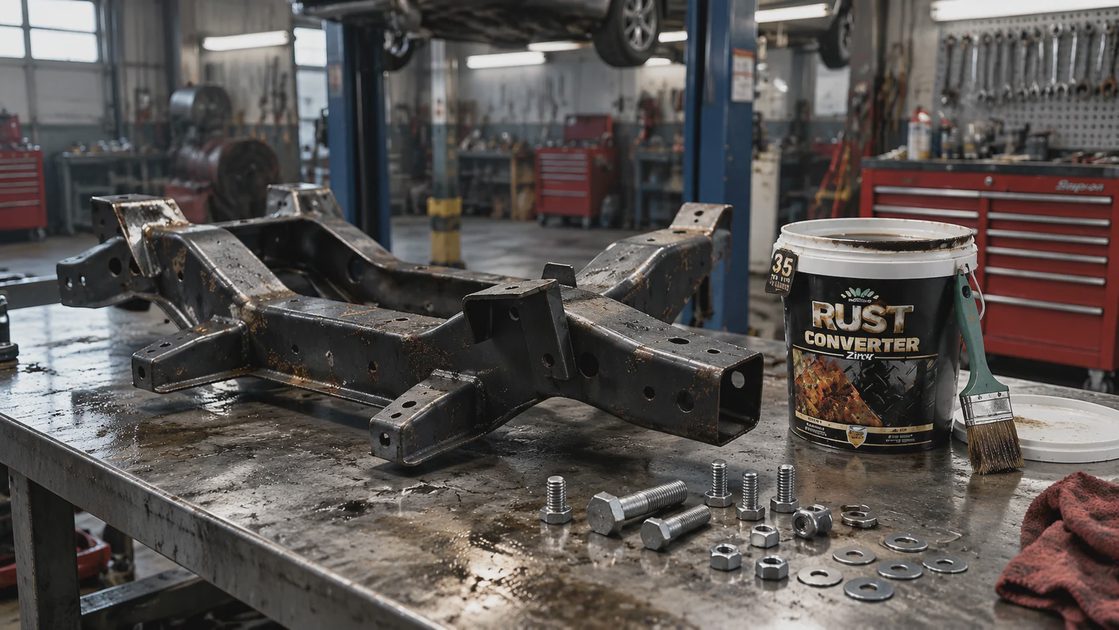
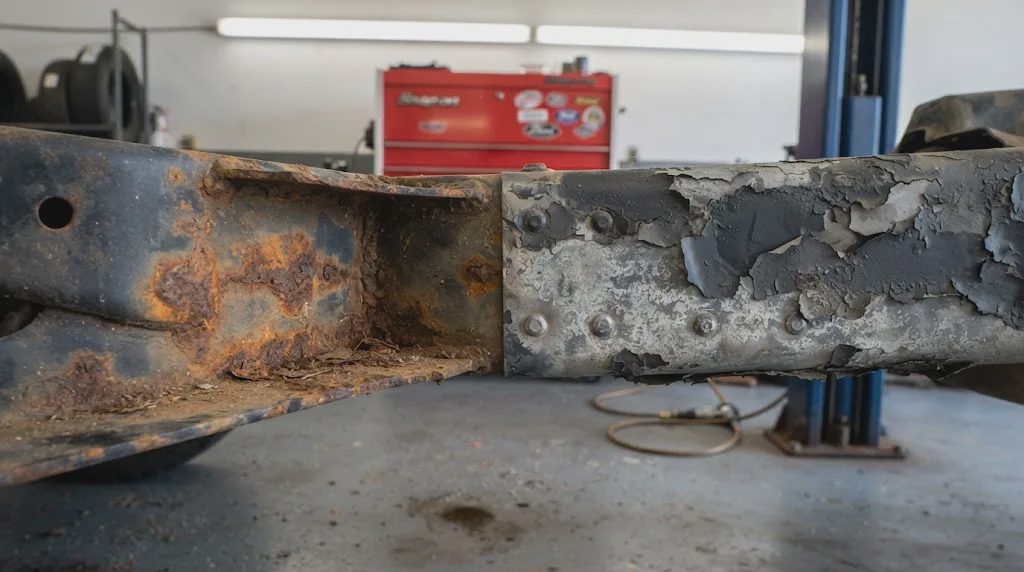
A 2008 F-250 came onto the lift with a frame that had already been “fixed.” The owner was still mad about the money he spent on a cheap undercoating that was now peeling in sheets. Orange rust had chewed back into the frame rails and one crossmember. Last time someone just covered the problem. I was not about to do the same thing on my lift.
I did not order some laboratory-grade system that costs half a day’s labor. I walked out and bought a 35 oz can of the Meuvcol 2 in 1 Rust Converter & Metal Primer myself for $26.99. No free sample. I treated a section of the F-250 frame rail, the crossmember, a utility trailer tongue that rolled in the same week, and I left an untreated control patch on the trailer so I could watch the difference with my own eyes.
🛒 Check Price & Reviews on Amazon
Shop Notes
Truck: 2008 Ford F-250
Condition: Surface rust, no structural perforation
Product: Meuvcol 2 in 1 Rust Converter & Metal Primer, 35 oz
Cost: $26.99 (bought myself)
Coats: Two thin coats
Cure time before topcoat: 24 hours
Control: Untreated patch on trailer tongue
What I Wanted to Know
Four questions only:
Does it actually convert remaining surface rust?
Does the film stay bonded after curing?
Can I put an oil-based topcoat over it without lifting?
Would I use it again on a truck frame—or on something my own family drives?
I expected the color change. I was less sure about the seal and whether a topcoat would stick on a real frame that still had texture. I have seen too many coatings that look good for a week and then start letting moisture back in. That is the kind of slow failure that costs a customer more than the original can ever saved them.
How I Prepped the Metal
Loose scale came off with a wire wheel and a flap disc. Anything that moved under the tool had to go. What stayed was tightly bonded surface rust that still had solid metal underneath. I degreased with mineral spirits, wiped dry, and let the solvent flash completely. No media blast. No chase for bright steel. On a frame with only surface rust, chasing bare metal is extra labor that does not change the result if the remaining rust is sound. If I had seen perforation or deep pitting that thinned the section, I would have cut and welded. A converter is not a substitute for metalwork.
Same rule I use when I tie a fly at 5:30 on the Blue River—rush the prep and you spook the whole job. Same rule when I check the edges on the kids’ hockey skates: if the foundation is wrong, everything downstream fails. I worked the frame section by section, stopping every few minutes to feel for remaining scale with a gloved hand. If it moved, it came off. If it stayed put, I left it for the converter.
🛒 Check Price & Reviews on Amazon
What Happened After Two Coats
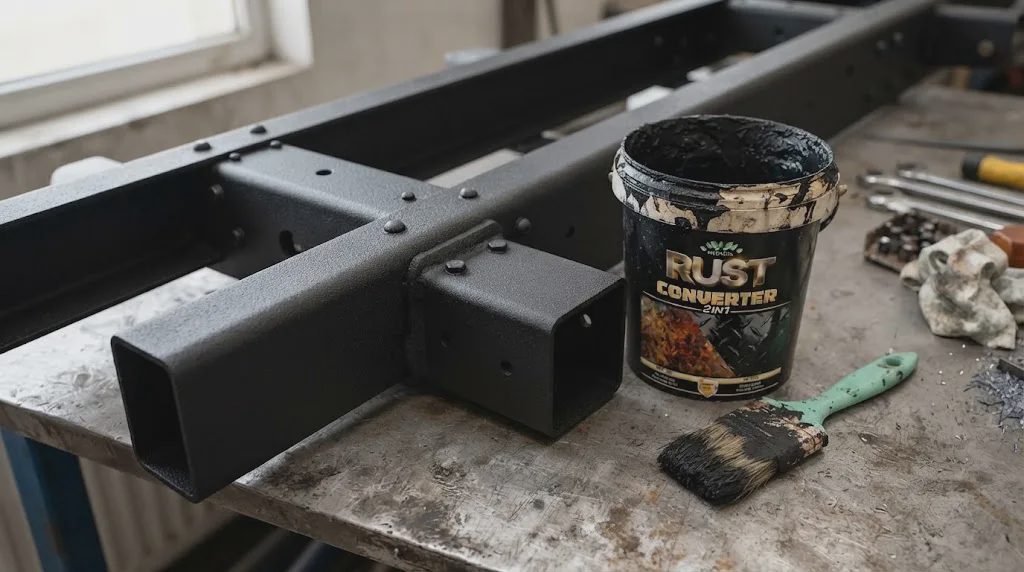
I brushed the first thin coat. It went on evenly as long as I kept it thin. The material has enough body to cover without running if you do not load the brush. Within a couple of hours the orange-red areas shifted to charcoal black. That is the conversion reaction. I left it overnight in the bay with the doors cracked for airflow. The next morning I applied the second thin coat the same way and waited the full 24 hours the label calls for before any handling or topcoat.
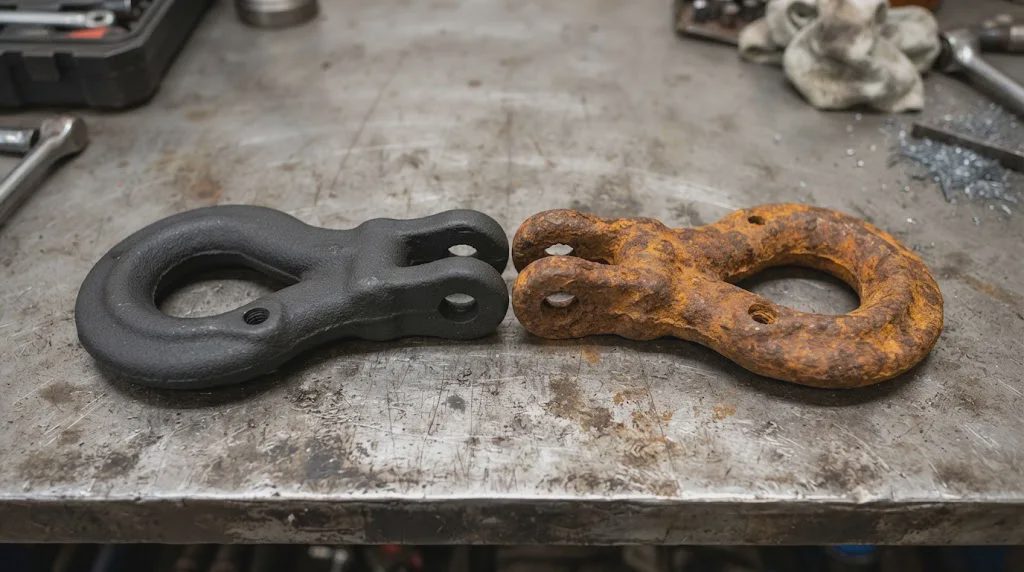
After the cure the treated surfaces felt dry and firm under my fingertips. No soft spots, no bubbles, no orange bleed-through at the edges. I laid a light oil-based topcoat on a small section of the frame rail and watched it for another day. It bonded cleanly with no lifting or wrinkling. Two weeks later the untreated control patch on the trailer still showed active orange rust spreading at the edges. The treated section next to it stayed stable and black. That side-by-side is the part that settled it for me. Looking good right after application is easy. Holding up next to an untreated control after real weather is the only test that counts.
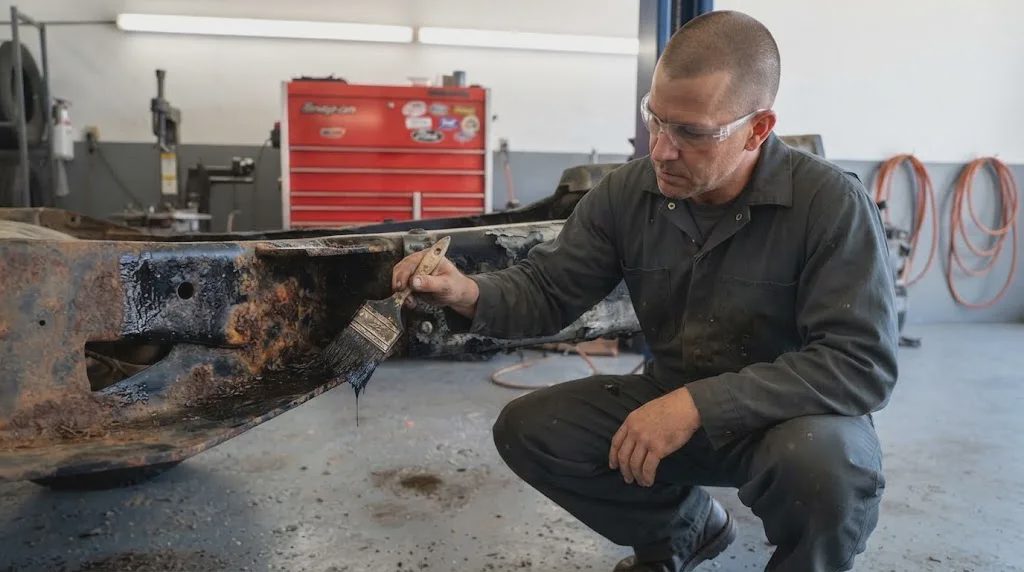
I could not get a reliable coverage number from the can, so I am not inventing one. On a truck frame the remaining texture and the amount of residual rust change how much material you use. The 35 oz can was enough for the sections I treated with some left over for the trailer tongue and a couple of brackets.
What I Did Not Like
The odor is strong. I opened the bay doors and ran the exhaust fan the whole time. Thin coats are required; a heavy single coat can skin over and leave soft spots underneath. The finish is flat industrial black—nothing pretty about it. And nothing about this product repairs metal that is already perforated or structurally weak. Deep pitting still needs metalwork. If the section has already lost thickness, no coating changes that fact.
I also would not use it as the only protection on a high-abrasion underside that sees constant road spray and gravel. It is a converter and primer, not a thick undercoating. Expecting it to do both jobs is how people end up back on the lift a year later.
Rust Converter vs. Just Painting Over Rust
Painting over loose scale or active surface rust is why the customer’s first undercoating failed. The rust kept growing and pushed the coating off. A converter that turns remaining iron oxide into a stable film and then seals it gives the next coat something solid to bond to. That only works after the loose material is gone. Tightly bonded surface rust can be converted. Loose scale cannot. Perforation cannot. The distinction is the whole job.
I have watched too many weekend jobs fail for the same reason: the owner spent more time choosing a pretty black finish than making sure the metal underneath was ready. The $26.99 can does not fix bad prep. Nothing does.
Where I Would Use It
Surface rust on truck frames, trailer tongues, brackets, and tools after the loose scale is removed. Spot work on chassis sections where the metal is still sound. The $26.99 can is enough for the limited repairs that show up on used trucks and older trailers without committing to a full undercoating job that can run into real money. I would use it the same way on the kind of surface rust that shows up on a daily-driven truck that sees winter salt but has not yet developed holes.
Where I Would Not Use It
Perforated metal or deep structural corrosion. Severe pitting that has already thinned the section. High-abrasion underside areas if this is the only coating. Loose scale that has not been cleaned first. Situations that need a thick, flexible undercoating as the primary protection. I would not trust it as the sole long-term protection under an entire truck that sees constant road debris and salt. And I would not put it on anything that needs structural repair and then call the job finished.
My Verdict
For surface rust on a sound frame or trailer after proper prep: yes. I would buy the same can again and use it the same way. For structural rust, perforation, or deep pitting: no. That is metalwork, not a coating job. For a full high-abrasion undercarriage as the only protection: not by itself.
A $26.99 can used in the right place after the right prep beats a few hundred dollars spent on a coating that peels in a season or a shop invoice for work that did not need to be that expensive. I have seen customers spend more fixing a failed undercoating than the original job ever cost. That is the kind of cycle I try to stop on my own lift.
Prep still matters. Thin coats still matter. The 24-hour cure still matters. The control patch still matters.
The bolt doesn’t lie.

No letters yet — pray write the first.