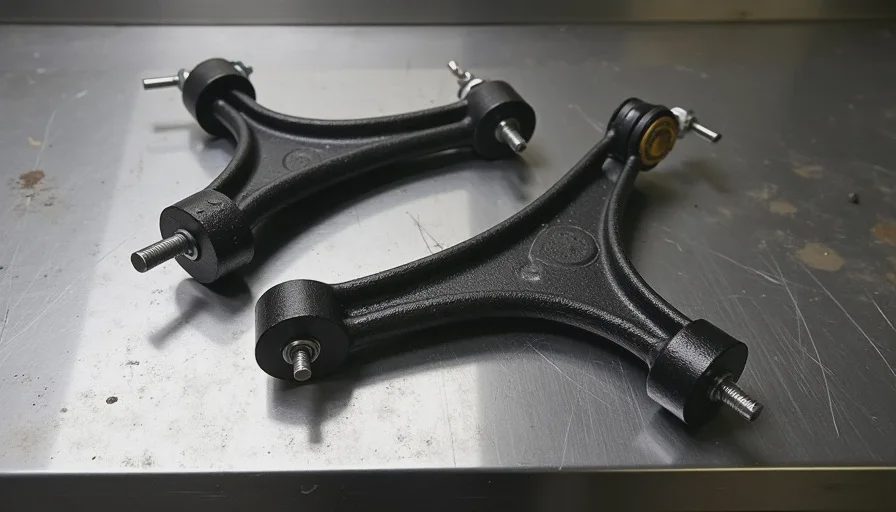
I had a customer come in last month with a 2018 Tacoma. He'd installed a 2-inch lift with aftermarket upper control arms. The brand was one of the popular ones on the forums. He was proud of the install.
Then he had me do an alignment. The numbers were off. I couldn't get the caster into spec. The aftermarket arms were shorter than the OEM ones—by almost 3/8 of an inch.
He was confused. "But the forum guys said these were better."
Better at what? They were lighter. They looked cooler. They were worse at keeping the wheel centered.
I decided to do a real comparison. OEM vs. aftermarket. Weighed, measured, and mic'd.
The Contenders
OEM Control Arm (Toyota Genuine)
Material: Stamped steel, seam-welded
Weight: 12.4 lbs each
Bushing type: Rubber, vulcanized in place
Ball joint: Pressed-in, sealed unit
Length (center-to-center): 17.25 inches
Aftermarket Control Arm (Popular Brand)
Material: 1/4-inch steel plate, welded box construction
Weight: 13.2 lbs each
Bushing type: Polyurethane, bolt-in
Ball joint: Bolt-in, greasable
Length (center-to-center): 16.875 inches
The Measurement Process
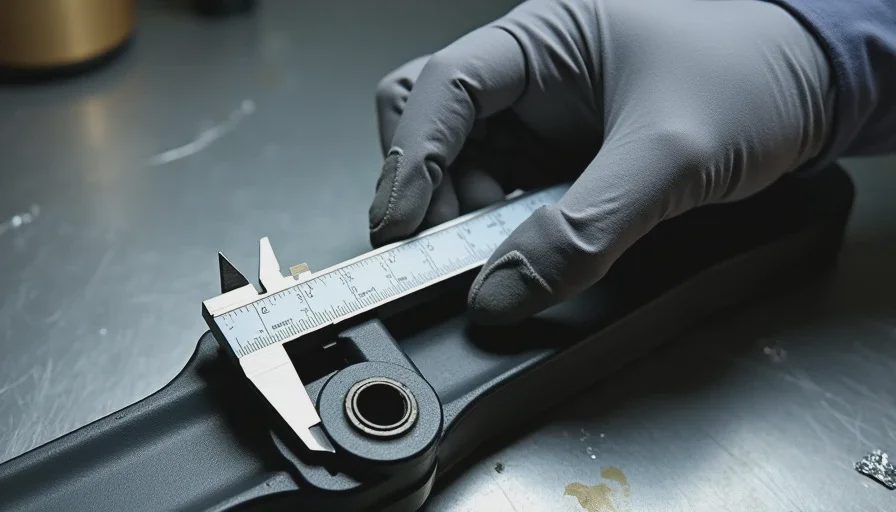
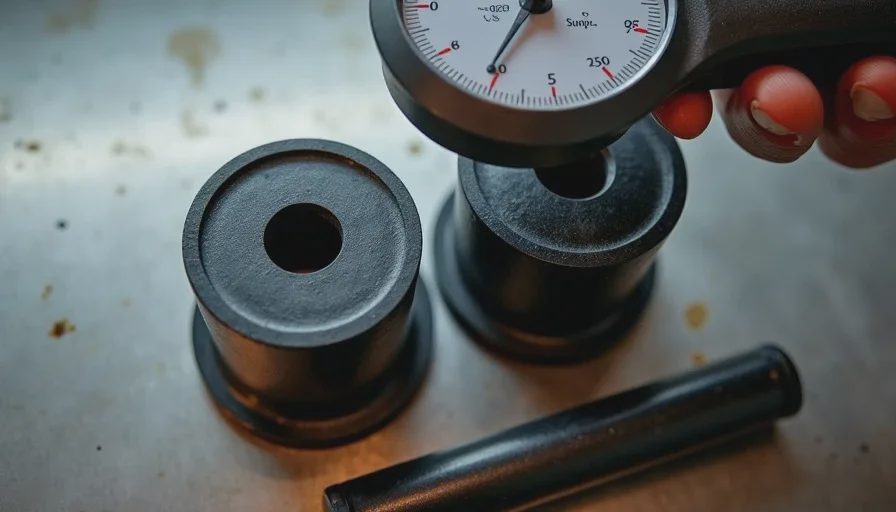
I measured each arm with a caliper and a tape measure. I weighed them on a shop scale. I checked the bushing hardness with a durometer. I measured the ball joint angle at ride height.
Here's what I found.
The Data
Measurement | OEM | Aftermarket |
|---|---|---|
Weight | 12.4 lbs | 13.2 lbs |
Length (center-to-center) | 17.25 in | 16.875 in |
Bushing hardness (durometer) | 68 | 85 |
Ball joint angle at ride height | 8 degrees | 6 degrees |
Grease fitting | None | Yes |
Estimated lifespan | 60,000+ miles | 30,000-40,000 miles |
What the Numbers Mean
Length difference: The aftermarket arm is 0.375 inches shorter. That doesn't sound like much, but it's enough to change the caster angle by 1.5 degrees on a Tacoma. That's the difference between a truck that tracks straight and a truck that wanders.
Bushing hardness: The OEM bushings are softer. They absorb road vibration better. The polyurethane bushings are stiffer. They transmit more road noise and vibration to the cabin.
Ball joint angle: The aftermarket ball joint sits at a different angle at ride height. It's not an issue on a stock truck. On a lifted truck, the ball joint is at a more extreme angle, which wears it out faster.
The Hidden Differences
There are things I can't measure on a bench that matter just as much:
Ball joint quality: The OEM ball joint is made by a Tier 1 supplier. I've seen aftermarket ball joints fail at 30,000 miles.
Bushing durability: The polyurethane bushings wear faster. They also squeak. I've had customers come back after 10,000 miles complaining about squeaks.
Fitment: The OEM arm fits perfectly every time. The aftermarket arm fits... most of the time. Sometimes I need to massage the mounts.
When Aftermarket Makes Sense
I'm not saying aftermarket control arms are always bad. They have a place.
When to Use Aftermarket
Lifted trucks over 3 inches: The OEM arms aren't designed for the new angles. Aftermarket arms with corrected geometry are necessary.
Adjustable arms: Some aftermarket arms are adjustable. You can fine-tune the caster and pinion angle. That's useful on a dedicated off-road truck.
Heavy-duty use: If you're hard on your truck—rock crawling, desert running—aftermarket arms are stronger. They can take more abuse than OEM arms.
Cosmetic preference: This is honest. Some people want the look. I get it.
When to Stick with OEM
Daily drivers: The OEM arms ride better. They last longer. They're quieter.
Moderate lifts (2 inches or less): The geometry isn't changed enough to need aftermarket arms. The OEM arms work fine.
Budget builds: OEM arms are cheaper. They do the job.
Street trucks: You don't need the extra strength. You need the better ride.
The Customer's Tacoma
I told the customer the truth. "The aftermarket arms are too short. They're giving you caster problems. If you want it to drive right, you need to either go back to OEM or get adjustable arms that are the correct length."
He was disappointed. He'd spent $400 on the arms. I'd cost him $100 for the alignment and $200 to diagnose the problem. He ended up buying OEM arms from the dealership for $350. I installed them. The alignment came in perfect. The truck drove straight.
"The forum guys were so sure these were better," he said.
"Better at marketing," I said. "Not better at geometry."
The Rule: Understand What You're Buying
Every aftermarket part has trade-offs. Lighter isn't always better. Stiffer isn't always better. Adjustable isn't always better.
Before you buy control arms, ask:
What's the length? Is it the same as OEM?
What's the bushing material? Will it ride differently?
What's the ball joint angle? Is it correct for my lift height?
Do I actually need this?
The forum guys will tell you what to buy. I'll tell you to measure first.
The bolt doesn't lie. And neither does a caliper.


No letters yet — pray write the first.