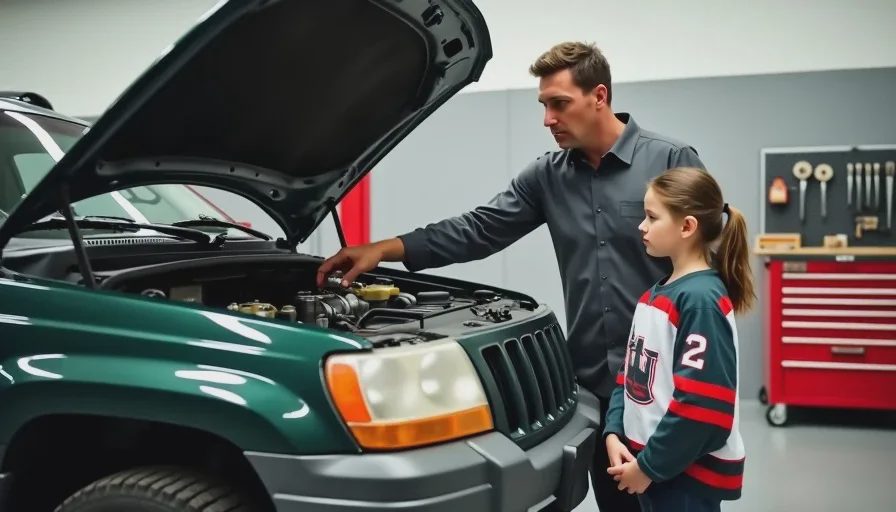
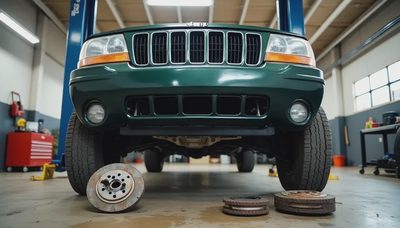
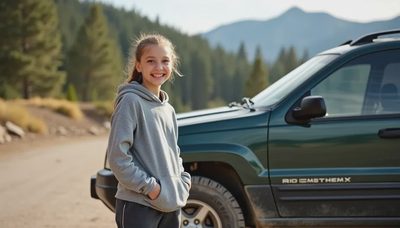
Emma's been watching me work on the WJ for three months. She's seen me replace the brakes, the ball joints, the cooling system, and the tires. She's helped with some of it. She's been in the shop almost every day after school.
Last week, she asked me a question I knew was coming. "Dad, when can I take it off-road?"
I didn't say no. I said, "Not until you can tell me the difference between a live axle and IFS."
She looked at me like I'd asked her to solve a calculus problem. "What's IFS?"
"That's exactly why you're not ready."
The Quiz I Gave Her
I sat Emma down in the shop on a Saturday morning. I opened the hood of the WJ and pointed at the front axle.
"Emma, this is a live axle. It's a solid piece of steel that connects the front wheels. When one wheel goes up, the other goes down. That's the principle of a solid axle. Off-road, it keeps the tires on the ground."
She nodded. "So what's IFS?"
I walked her over to a Tacoma that was in for service. I pointed at the independent front suspension.
"This is IFS. Independent front suspension. Each wheel moves independently. When one wheel goes up, the other stays where it is. That gives you a better ride on pavement. But off-road, it's different."
The Questions
I gave her a quiz. Five questions. She had to get them all right before she could drive the WJ on dirt.
Question 1: What's the difference between a live axle and IFS?
Her answer: "Live axle moves together. One wheel goes up, the other goes down. IFS moves separate. Each wheel does its own thing."
I nodded. She nailed it.
Question 2: Which one is better off-road?
Her answer: "Live axle. It keeps the tires on the ground more. But it rides rougher on the road."
Right again.
Question 3: Why does the WJ have a live axle?
Her answer: "Because it's old school. And because you built it to be simple and tough. The IFS truck is newer and rides better on the street."
She was getting it.
Question 4: If you took the WJ off-road with a live axle and the Tacoma with IFS, which one would flex better?
Her answer: "The WJ. Because the live axle can twist and keep both tires down. The IFS might lift a tire."
Perfect.
Question 5: Why did I ask you these questions before you could drive on dirt?
She thought about this one for a minute. Then she said, "Because you want me to understand what the truck is doing. Not just how to steer it."
That was the answer I wanted.
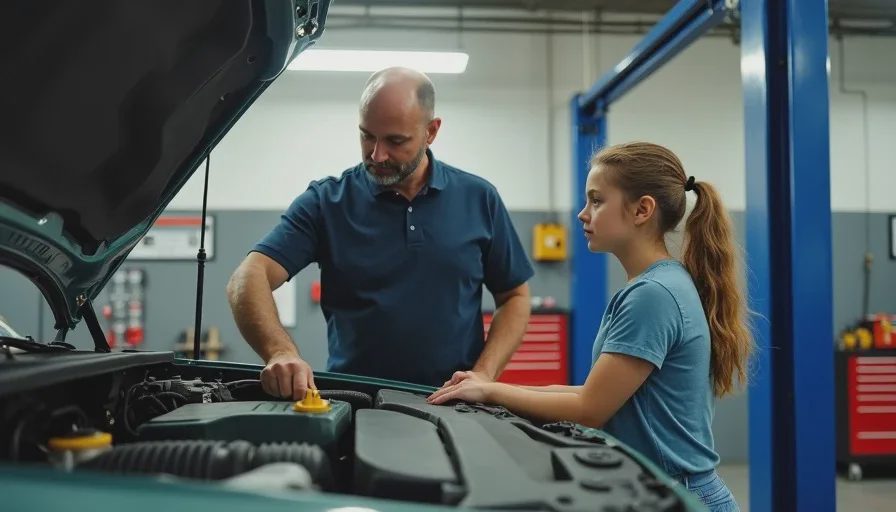
The Off-Road Lesson Plan
Emma passed the quiz. Now she gets to start learning how to drive off-road. But I'm taking it slow.
Here's my plan for Emma's off-road education:
Stage 1: The Theory
Understand the drivetrain: engine, transmission, transfer case, axles.
Know when to use 4-Hi vs. 4-Lo.
Understand the concept of center of gravity and tipping angles.
Learn basic recovery principles.
Stage 2: The Parking Lot
Practice steering on dirt in a controlled environment.
Feel the difference between 2WD and 4WD.
Practice turning in loose gravel.
Learn to feel when the wheels start to slip.
Stage 3: The Fire Road
Drive on a graded dirt road. No obstacles. Just dirt.
Practice maintaining speed on loose surfaces.
Learn to handle washboards.
Feel how the truck tracks differently on dirt vs. pavement.
Stage 4: The Easy Trail
A beginner off-road trail with no rocks.
Practice picking a line.
Learn to use momentum.
Understand when to air down.
Stage 5: Recovery Practice
Learn how to use a tow strap.
Understand the safe recovery points on the WJ.
Practice recovering a stuck vehicle (with supervision).
Always have another truck along.
Stage 6: The Real Trail
A moderate trail with the other truck along.
Emma drives. I spot. She learns.
We take it slow. We take it safe.
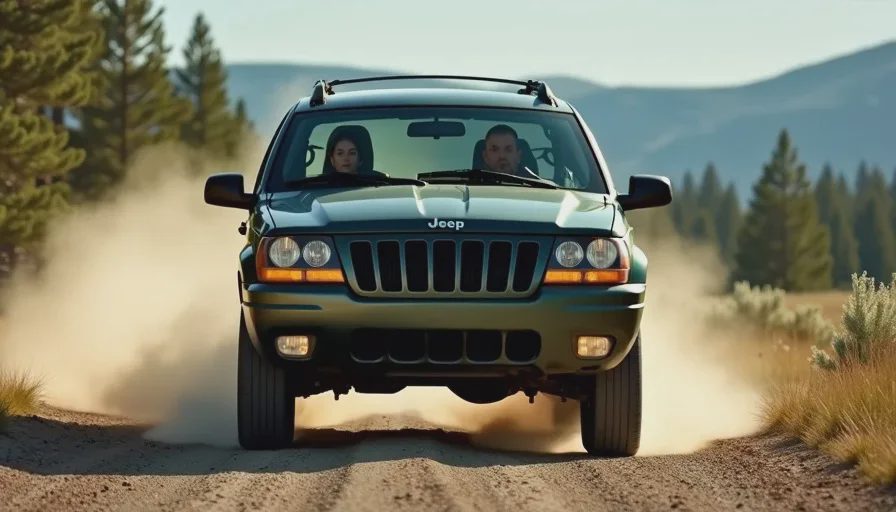
The Conversation About Responsibility
After the quiz, I had a longer conversation with Emma. It wasn't about mechanical differences. It was about responsibility.
"Emma, off-roading isn't a video game. Every move you make in a truck has real consequences. If you choose the wrong line, you can get stuck. If you choose the wrong line at speed, you can roll."
She was quiet.
"I'm not trying to scare you. I'm trying to prepare you. Off-roading is fun. It's rewarding. But it's also serious. When you're driving on dirt, you're not just navigating the trail. You're navigating risk. You need to understand what the truck is doing and why. Because if you don't, you're making guesses."
She said, "That's why you asked about the live axle and IFS."
"Exactly. You need to know how your truck works. Not because you're going to rebuild it on the trail. Because you need to understand its limits. If you know the limits, you can drive right up to them and stay safe. If you don't know the limits, you'll find them the hard way."
The Rule
Emma isn't going off-road alone. She'll always have another truck with her. She'll always have recovery gear. She'll always have a spotter until she proves she can pick her own lines.
She knows the rule. The bolt doesn't lie. And neither does a truck that's pushed past its limits.

No letters yet — pray write the first.