
A 2014 Tacoma came in last winter that wouldn’t crank. Owner had parked it for twenty-one days while he was out of state. No radio left on, no dome light, nothing obvious. At my shop in Silverthorne I put the multimeter on it and measured a parasitic draw of about 50 milliamps. The draw wasn’t dramatic, but on a battery that was already sitting for three weeks, it was enough to leave the truck unable to crank. We jumped it, charged it, and the customer asked the same question I hear every storage season: is there a clean way to stop the draw without yanking the negative cable every time?
That’s the problem I was actually trying to solve. Not “add another gadget.” Just stop the slow bleed when a truck is going to sit.
🛒 Check Price & Reviews on Amazon
Around here a truck can sit for two weeks while its owner is skiing, hunting, or waiting for the weather to turn. That’s long enough for a small draw to become a real problem. I’ve used battery tenders for stored vehicles. They’re fine when you have a reliable outlet nearby. Half the trucks that come into my shop for storage don’t. A manual disconnect is simpler when the job is simply: open the circuit and stop the draw.
What I Bought for $15.97
I ordered a two-pack of the rotary battery disconnect switch for 8 each. Cheap enough that I don’t expect fancy hardware. I expect a solid connection, clean switching, and no new electrical problem.
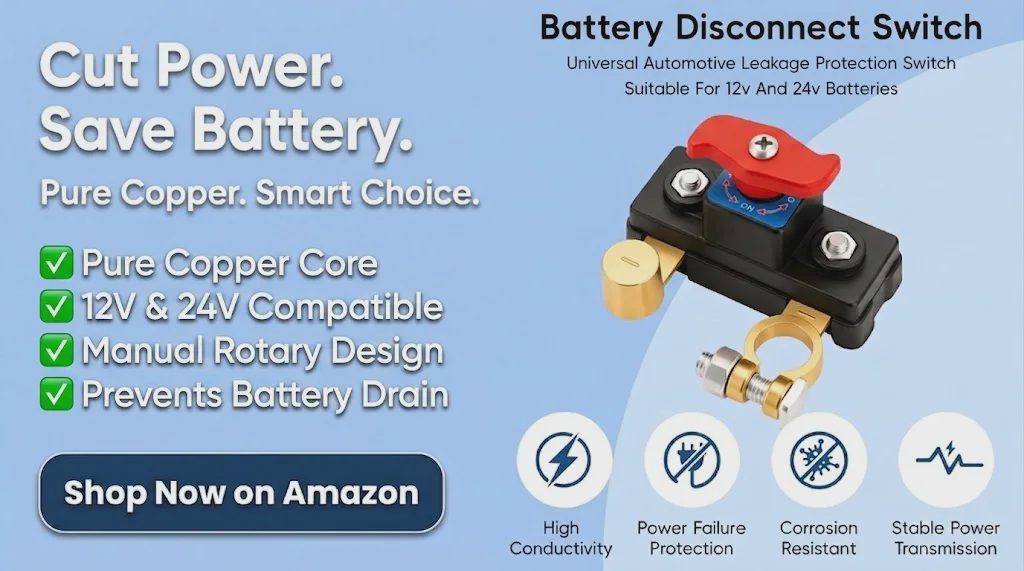
The manufacturer lists pure copper contacts, 12-volt and 24-volt compatibility, and a 250 A continuous rating. Compact size—roughly 3.3 × 3.1 × 2.2 inches. Rotary handle: 90 degrees up to open the circuit, down to close it. No electronics, no remote, no app. Two switches in the box.

The label says 12 and 24 volts. That’s useful if you’re working across trucks, trailers, or some RV setups. I wouldn’t read it as a blanket claim that this switch belongs on every high-load electrical system. The 250 A continuous rating is where I pay attention. For a typical truck starting system, that rating is comfortably within the range I’d expect this kind of switch to handle. It is not an invitation to hang every high-draw accessory behind it.
I Put One on a Silverado and One on My Shop Truck
On the 2008 Silverado that sits most of the week, the actual installation took me about twelve minutes with basic hand tools. Surface-mount, through-hole terminals. I disconnected the negative cable first, cleaned the contact surfaces, and mounted the switch. Clear mechanical positions—no ambiguity about whether the circuit is open or closed.
The second unit went on my own shop truck, the one that sometimes sits four or five days between jobs. Same process. I also put one on a 2012 JK that only sees weekend use. Those three vehicles became the real test cases.

What Changed After the Truck Sat
On the JK, the owner used to come back from a two-week work trip and need a jump. After eighteen days of sitting, I checked the battery and it was still above 12.6 V. That told me what I needed to know. The Silverado showed the same practical result: it started normally after sitting most of the week. The shop truck simply stopped needing a tender when it sat between jobs.
🛒 Check Price & Reviews on Amazon
What I Like About the Switch
The rotary action has a positive detent. You feel it. The contact material matters more to me than most of the packaging language. What I care about is whether the contact surface stays clean and maintains a solid connection in the real world. The manufacturer lists an IP67 rating. That’s useful information, but actual corrosion resistance is something I’d rather judge over time than from a label.
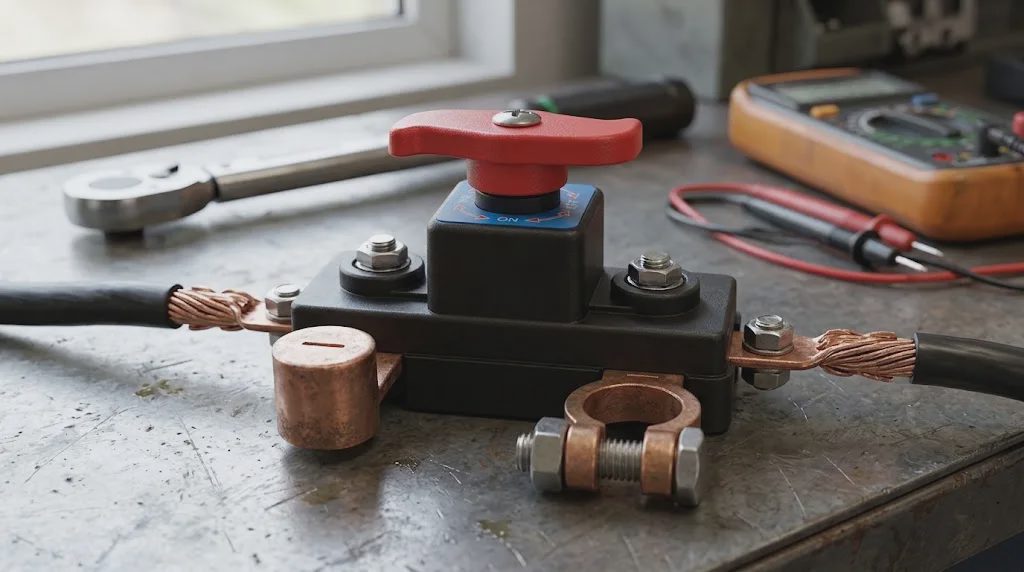
Installation is straightforward on vehicles with reasonable access to the battery. And because it’s purely mechanical, there’s no firmware to update and no remote to lose.
A few practical points that matter on the shop floor:
Clear on/off positions with a positive mechanical feel
No electronics to fail or confuse
Compact enough to fit most standard battery trays
Two units in the package for a truck plus a trailer or second vehicle
🛒 Check Price & Reviews on Amazon
Where I Wouldn’t Use It
I would not put one on a dual-battery setup running a large inverter without looking at the whole electrical system first. It is not designed for constant high-amperage accessory use. If you’re powering a 2000-watt inverter for hours, this is the wrong tool.
I also wouldn’t recommend it for vehicles where isolating the battery can create electrical-system problems or reset important settings. And if your battery tray is extremely tight, the surface-mount design may force a short cable extension or a different mounting location. Measure first.
These are not remote or solenoid units. If you need to kill power from the cab without walking to the battery, pay for that capability. This switch is for the simpler case: the truck is going to sit, and you want a clean way to stop the draw.
$15.97 vs. Paying More
There are more expensive disconnect options—remote units, solenoid-operated systems, and setups designed for dual-battery builds. If you need remote control or higher continuous ratings for a specific high-load system, pay for it. If you just need to isolate a battery on a truck that sits for three weeks, I don’t see the point in paying several times more for features you’re not going to use.
What you need | Manual rotary switch like this | Higher-priced remote / solenoid options |
|---|---|---|
Stop parasitic drain on a sitting truck | Yes | Yes |
Remote control from the cab | No | Yes |
Dual-battery high-load systems | Usually no | Often designed for it |
Simple mechanical isolation | Yes | Usually more complex |
Cost for a basic two-pack | About $16 | Several times more |
At about $8 each, I’m not buying it because it’s cheap. I’m buying it because the job it does is simple: open the circuit, stop the parasitic draw, close the circuit when you’re ready to drive. No more, no less.

Who This Makes Sense For
This makes sense for owners whose vehicles actually sit for a week or more at a time. Weekend truck owners. Overlanders staging a second vehicle or trailer. RV and boat owners storing equipment for months. Classic truck guys who only drive on nice Sundays. Anyone who’s already replaced a battery earlier than expected because something kept sipping power all winter. In the shop we see the same pattern every spring: batteries that were fine in November are dead by March.
It also gives a clean way to isolate the battery during electrical work. Rotate the handle, confirm the circuit is open, then work. No more watching a wrench slip against the positive terminal while the negative cable is still connected.
The Bottom Line
At $15.97 for the pair, I don’t expect this switch to replace a properly diagnosed electrical system. It doesn’t. What it does is simpler: when a truck is going to sit for weeks, it gives you a mechanical way to stop the draw instead of hoping the battery survives it.
The handle still clicks with a positive detent, and the switch does exactly what I bought it to do. For this kind of job, that’s enough.
The bolt doesn’t lie, and neither does a multimeter when you know what you’re looking for. If your truck, RV, or trailer spends more time sitting than moving, this is a simple way to keep the battery ready when you need it.




No letters yet — pray write the first.