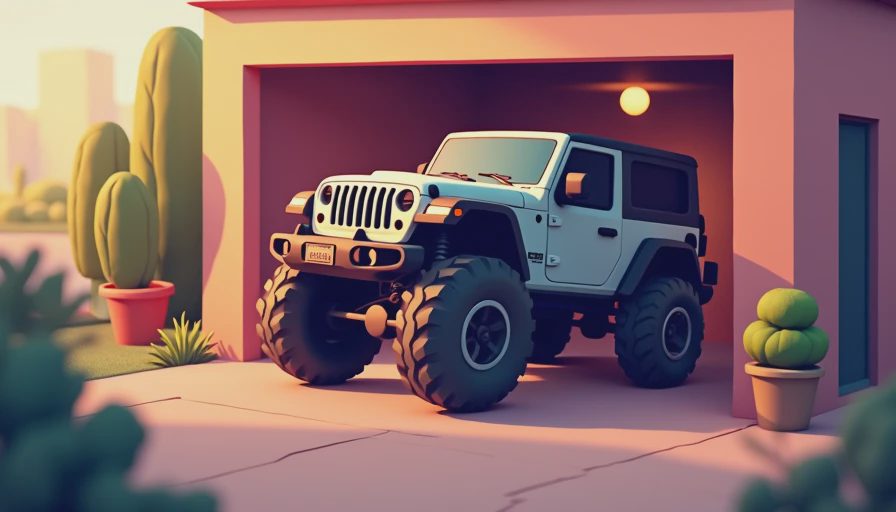
If you're asking what is the jeep death wobble, the short answer is a violent front-end oscillation in a solid-axle Jeep that starts after a bump and keeps shaking until speed drops. It is not just a tire balance issue, and it is not normal Wrangler character. In the shop, I treat it like a loose bolt somewhere in the steering or suspension until proven otherwise. The steering wheel can rip side to side, the hood can blur, and the driver feels like the Jeep is trying to leave the lane. That is the part people remember. The part they miss is that a small amount of play, often in the track bar, can wake the whole front end up like a bad coffee grinder.
How it starts and why it gets ugly fast
A Jeep with a solid front axle is sensitive to side-to-side movement. Hit a pothole, bridge seam, or washboard road, and one loose joint lets the axle shift just enough to start a shake. Then the drag link and tie rod follow, the steering wheel feeds the motion back, and the wobble gets louder with each cycle. Worn ball joints, loose control arm bushings, bad track bar bushings, and out-of-round tires can all add fuel to the fire. Lift kits make the setup more sensitive because the geometry changes and the suspension has less margin before things start to resonate. I have seen 35-inch tires, a two-inch spacer lift, and 120,000 miles on the clock turn a mild shimmy into a full-on panic stop.
The first parts I check in the bay
Any time a driver asks what is the jeep death wobble, I point at the parts that control side-to-side load first. The track bar gets my attention before the steering stabilizer, every time. I want to see the frame-side bolt, the axle-side bolt, the bushings, and the bracket holes. If the axle can move sideways even a hair before the tires respond, the Jeep has a problem. A pry bar and a helper in the driver seat will usually tell the story faster than a forum thread.
After the track bar, I check drag link ends, tie rod ends, ball joints, wheel bearings, and the control arm bushings. A loose unit bearing or a worn ball joint can show up as play at 12 and 6 o'clock or 3 and 9 o'clock when I shake the tire by hand. If I can see the tire move and the steering linkage lag behind it, I already know which direction the money is going. On a lifted Wrangler, I also look for a bad alignment and a front end that is sitting off-center, because a crooked axle can hide a bigger problem.
Things that fool people into buying the wrong parts
The steering stabilizer gets blamed because it is easy to replace and it looks like a shock absorber for the steering. It is not a cure. It only damps motion. If the track bar is loose, the stabilizer is just wearing a suit to a bar fight. Tires can also fool people. A tire with a broken belt, a bad road-force balance, or uneven wear can shake the wheel, but that is not the same as death wobble. Tire balance problems usually show up at a certain speed and feel like a shake. Death wobble is a sudden violent event that starts after a bump and keeps going until the driver slows down.
Alignment is another place people spend money before they spend time. Toe and caster matter, but alignment numbers are chasing a moving axle if the hardware is loose. New shocks can mask the symptoms for a week or two, then the shake returns the first time the Jeep hits a rough patch. I have also seen cheap steering kits with sloppy ends and soft hardware make the problem worse. If the part looks like it came from a no-name warehouse and the threads feel crunchy going in, that is usually a sign.
The repair order that actually works
The fix is not magic, and it is rarely one part alone. I start with a full torque check on every front steering and suspension fastener, then I replace anything worn or wallowed out. Track bar hardware has to be tight enough that the bracket does not move under load, and the bushings need to be snug, not cracked or oval-shaped. If the bracket holes are egged out, a new bolt will not save you. The bracket has to be repaired or replaced.
Then I move to the steering linkage and front axle joints. If tie rod ends are loose, if ball joints have play, or if the drag link has slop, I replace them with quality parts from Mopar, Dana Spicer, Moog, or another brand with real hardware, not bargain-bin mystery metal. After that, I set the alignment. On many lifted Wranglers, caster in the mid-4 to mid-6 degree range is a good starting point, but I still go by the specific Jeep and the suspension under it. If the tires are cupped or a belt is bad, those tires come off the list too. A complete repair usually lands somewhere between a couple hundred bucks for a simple track bar fix and well over a thousand if ball joints, steering linkage, tires, and alignment are all involved.

How to keep it from coming back
Once you know what is the jeep death wobble, the prevention is boring in a good way. Recheck torque after the first 50 to 100 miles on any front-end repair. Look at the track bar bolts after a hard trail day, after a big pothole hit, or after a season of salted winter roads. Keep tire pressure even side to side. Rotate the tires before they get chopped up. If the Jeep has a lift, make sure the axle is centered and the steering wheel is straight after the alignment, not just "close enough." A Jeep that gets off-road use should have the front end inspected before the wobble shows up again, because small slop grows fast once the road starts talking back.
The cheap fix is usually the one that costs the most in the end. I have watched people buy a stabilizer, then buy tires, then buy shocks, and still end up paying for the track bar they skipped on day one. That is why I trust the bolt more than the guess.
Emma's Jeep update: the loose bolt everybody missed
A few winters back, a young driver rolled in with a JK that shook so hard on a highway bridge joint that both hands came off the wheel. The internet had already told him it needed a lift correction kit, a steering stabilizer, and probably a new steering box. I checked the front end, put a wrench on the track bar bolt, and found witness marks around the bracket. It had been moving every time the axle loaded up.
I checked.
One proper bolt, fresh hardware, and a road test later, the Jeep drove straight. The alignment was not perfect, but the wobble was gone because the real problem was gone. That is the job. Not buying parts. Finding motion where there should be none.
If you're still wondering what is the jeep death wobble after all that, remember this: it is not mystery grease or bad luck. It is looseness, leverage, and speed hitting the same weak point. Start with the track bar, then the rest of the front end, and fix the first loose bolt you find. The bolt doesn't lie.

No letters yet — pray write the first.