The parts catalog is a liar.
I've been buying suspension components for 20 years. I've seen the packaging get flashier, the price tags climb higher, and the actual quality go straight downhill. Every brand claims "heavy-duty." Every box says "off-road rated." Every product page shows a truck flexing on a rock. None of them show a section view of what's actually inside.
So I decided to find out for myself.
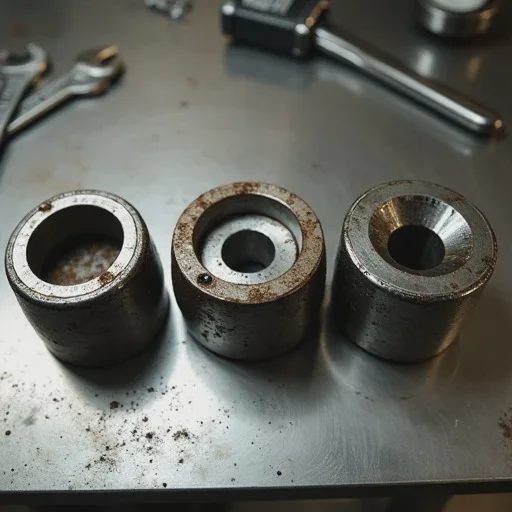
I bought three "heavy-duty" ball joints from three different price points. One cost $45. One cost $180. One cost $320. I took them to the shop, grabbed the bandsaw, and cut each one open. What I found underneath the chrome plating told me more than any marketing page ever could.
The Contenders: Three Price Points, Three Stories
I'm not naming brands in this post. That's not how I work. What I will do is show you exactly what I found. You can decide which one belongs on your truck.
Unit A: $45 (eBay Special)
This one showed up in a plain brown box. No branding. No spec sheet. Just the part, some Chinese-language instructions, and a grease fitting that felt loose in its threads.
What I found inside: The housing wall measured 2.5mm thick. The ball stud was pressed into a sintered metal socket with visible porosity. The grease cavity was almost empty—maybe 30 percent filled. The spring preload was uneven. I could push the ball stud side to side with my thumb.
The verdict: It's not heavy-duty. It's not even light-duty. This part would fail within 10,000 miles on a stock truck. On a lifted truck with bigger tires, I'd give it 5,000 miles. If it rains, less.
Unit B: $180 (Mid-Tier Brand)
This one came in retail packaging. Brand name on the box. Made in Mexico. Spec sheet included. Looked the part when I pulled it out of the box.
What I found inside: The housing wall measured 4.2mm thick. Much better. The ball stud was machined from a forging, not sintered. The grease cavity was about 80 percent filled. The spring preload was consistent.
The verdict: This is a decent part. It's not the best I've seen, but it would likely last 30,000 to 40,000 miles on a lightly modified truck. On a heavily built rig with 35-inch tires and a lift, you'd be replacing it in 25,000.
Unit C: $320 (Premium Brand)
This was the one I wanted to like. Premium packaging. Felt heavy in my hand. Assembled in the USA. The brand has a reputation that stretches back decades.
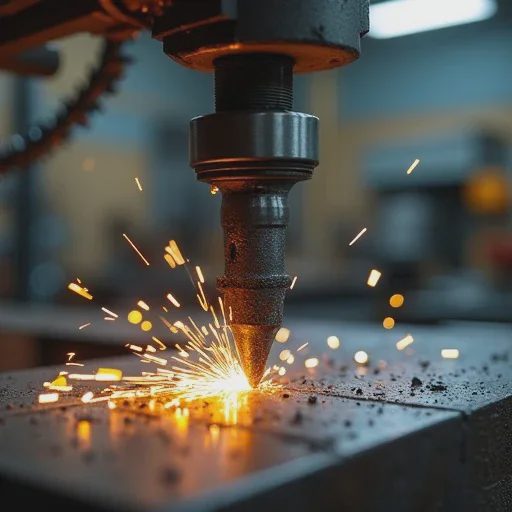
What I found inside: The housing wall measured 5.8mm thick. The ball stud was forged and heat-treated. The grease cavity was completely filled—not just packed, but filled with a high-quality synthetic grease. The spring preload was uniform across the full range of motion. The internal surfaces were machined to a smooth finish, not left rough.
The verdict: This is the real thing. It costs more because it costs more to make. The materials are better. The machining tolerances are tighter. The assembly quality is consistent. On a daily-driven truck, this part would outlast the axle housing.
The Numbers: What I Measured
Here's the raw data from my bench.
Measurement | Unit A ($45) | Unit B ($180) | Unit C ($320) |
|---|---|---|---|
Housing wall thickness | 2.5mm | 4.2mm | 5.8mm |
Grease cavity fill | 30% | 80% | 100% |
Stud material | Sintered metal | Forged steel | Forged/heat-treated |
Internal surface finish | Rough | Smooth | Polished |
Spring preload consistency | Uneven | Consistent | Uniform |
Boot quality | Thin rubber | Neoprene | Heavy-duty neoprene |
Estimated lifespan (lifted truck) | 5,000 miles | 25,000 miles | 50,000+ miles |
Why This Matters: What Happens When Ball Joints Fail
I've seen three types of ball joint failures in my shop. Each one is tied directly to the quality of the part.
Failure Type 1: Grease Starvation
The cheap units don't hold enough grease. The cavity is too small or poorly filled. After 5,000 miles, the ball stud is running metal-on-metal. The joint gets loose. The customer feels a clunk when turning. Then the death wobble starts. I've seen this hundreds of times.
Failure Type 2: Housing Cracking
This is the scary one. Thin housing walls can't handle the side loads of a lifted truck with big tires. I've seen housing cracks that started small and grew until the ball joint separated completely at speed. One of my customers had a wheel fold under his truck on a highway off-ramp. The ball joint housing had cracked. He was doing 50 mph. Nobody got hurt, but he needed new fenders, a new axle shaft, and new underwear.
Failure Type 3: Stud Shear
Sintered metal studs are brittle. They don't flex. They break. I've seen three cases in the last five years where a ball joint stud sheared off at the threads. The wheel went sideways. The brake line tore. The customer called me from the side of the road, his voice shaking. Every time, it was a cheap ball joint.
What I Put on My Daughter's Jeep
People ask me this all the time. Walt, you see all the parts. What do you actually use?
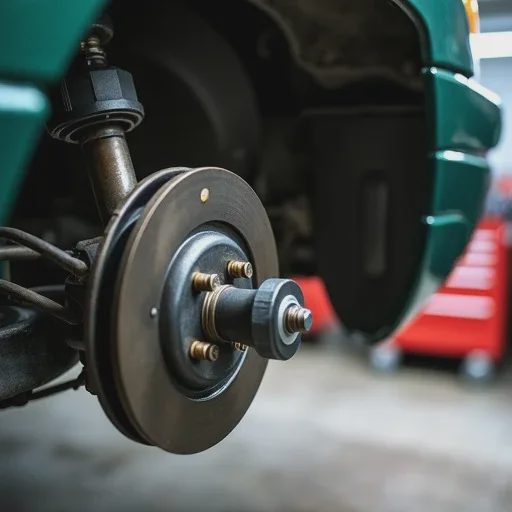
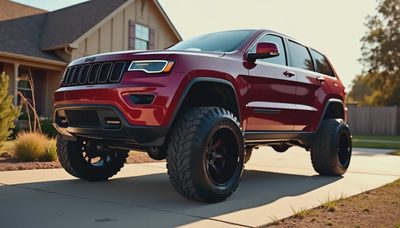
On Emma's WJ Grand Cherokee, I put Spicer ball joints. They're not the most expensive on the market, but they're the OEM supplier for Jeep. The housing wall thickness is in the 5mm range. The grease cavity is fully packed. The stud is forged and heat-treated. I can get them for about $160 a set if I buy direct. I've seen them last 60,000 miles on lifted trucks.
If you want to spend $320 on the premium brand, go ahead. It's a great part. But the difference between a $45 ball joint and a $160 ball joint is the difference between fixing it once and fixing it three times. The difference between a $160 and a $320 ball joint is incremental. Good parts don't have to be the most expensive. They just have to be made right.
How to Spot a Bad Ball Joint Before You Buy It
If you're buying ball joints online or at a parts store, here's how I screen them:
Lift the part. The heavy one is almost always the better one. Good steel weighs more than cheap steel.
Squeeze the boot. If it feels like thin rubber and squishes too easily, it's not going to hold grease. Good boots have some resistance.
Turn the stud by hand. There should be smooth, even resistance. If it's gritty or uneven, the internal surfaces are poor quality.
Check the country of origin. I'm not saying every Chinese part is bad. But every bad ball joint I've ever cut open was made in China.
Look at the grease fitting. If it's loose in the threads, the part was assembled carelessly. That's a red flag.
The Rule I Live By
I spend about $160 on ball joints for a customer's truck. That's not the cheapest option and it's not the most expensive. It's the minimum I trust on a vehicle that goes 75 mph down I-70 with a family inside.
The $45 option? I won't install it if a customer brings it to me. I tell them to take it back.
The $320 option? It's good. No complaints. But most people don't need it. The mid-tier premium is the sweet spot.
The bolt doesn't lie. And neither does a cut-open housing.


No letters yet — pray write the first.