If you are shopping for the best truck mud tires, start by admitting where the truck actually drives. A tire that shines in two feet of spring muck can be miserable on dry pavement, loud enough to loosen your fillings, and poor on packed snow. I have mounted hundreds of mud tires at my shop in Silverthorne, Colorado, and the tread pattern is only the first measurement. Load range, sidewall construction, wheel width, gearing, and your weekly commute matter just as much.
The internet loves a dramatic tire photo: a truck buried to the door handles with fresh rubber throwing rooster tails. That is not a tire test. It is a tire commercial with a winch nearby. Before you spend $1,200 to $2,000 on a set, decide whether your truck is a work tool, a trail rig, or a daily driver that sees a muddy campsite four times a year.
What makes a mud tire work
The best truck mud tires clear their tread when the ground is soft. Wide gaps between lugs let clay and wet soil release instead of packing into a smooth rubber ring. Open shoulders help when a tire is pushed sideways in a rut. A strong sidewall matters because rocks do not care how attractive your tread blocks look in a parking lot.
That same open design creates tradeoffs. Mud tires usually hum more than all-terrain tires, wear faster on hot pavement, and can follow grooves in the road. A heavy Load Range E tire can also make a half-ton truck feel slower and harsher. Do not confuse a stiff sidewall with better handling in every situation. It is better support under load, but an empty Tacoma or F-150 may ride like a lumber wagon.
Look at the tire's actual size, not just the advertised name. A 35-inch tire can measure differently from one manufacturer to another, and section width changes with wheel width. Check full steering lock, suspension compression, brake-line clearance, and the distance to the upper control arm. Tire rub is not fixed by optimism.
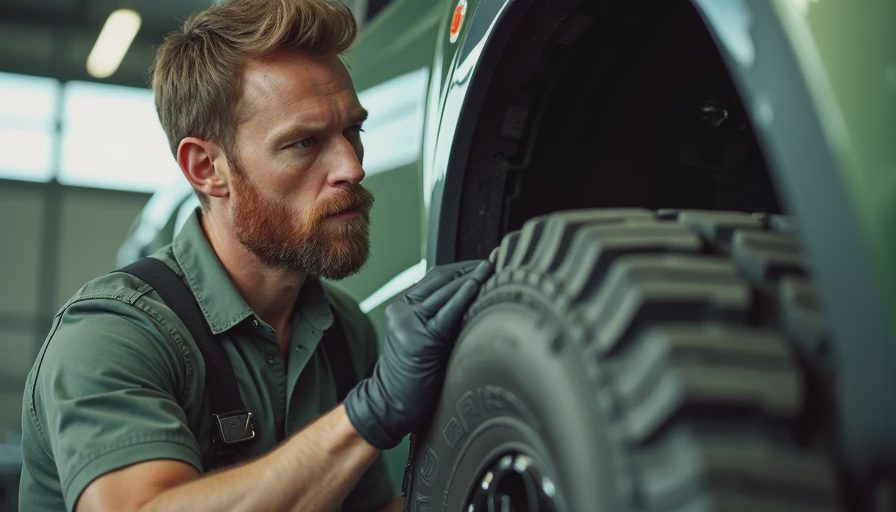
My short list from the shop floor
For a balanced mud-and-road setup, I regularly point people toward the BFGoodrich Mud-Terrain T/A KM3. Its sidewall protection is proven, replacement availability is generally good, and it behaves predictably on rocky trails. It is not quiet, and nobody should pretend otherwise. It is a sensible choice for a Jeep Wrangler, older Tacoma, or half-ton that sees genuine trail use.
The Falken Wildpeak M/T01 deserves attention when sidewall strength and winter capability matter. Its tread has enough void to work in mud without feeling completely unmanageable on the road. I have seen good results from it on overland builds that carry tools, recovery gear, and a rooftop tent. Still, rotate it regularly. A heavy tire with uneven wear becomes an expensive vibration machine.
The Nitto Trail Grappler M/T is often chosen by drivers who want aggressive appearance without giving up reasonable road manners. It is a popular fit for lifted Ram, Ford, and GM trucks. The Mickey Thompson Baja Boss M/T is another strong option, particularly for drivers who spend time on rock and sharp shale. Its sidewall construction earns the price when a torn sidewall would mean a long walk.
My advice is less glamorous than picking a winner: call two local tire shops and ask which sizes they can replace quickly. A great tire sitting in a warehouse three states away does not help when you cut one on a Friday afternoon.
Match the tire to the truck
A stock half-ton with 3.31 gears does not become trail-ready because you installed 35-inch tires. The larger diameter changes effective gearing, reduces acceleration, and can increase transmission heat. On many trucks, 33-inch tires are a more sensible compromise. They offer extra clearance while keeping the factory drivetrain from working as hard.
A three-quarter-ton truck has different problems. The axle and suspension can handle more load, but the tire must match the truck's required load rating. Read the door-jamb placard and tire-pressure information before buying. Do not lower pressure based on a random forum post. On a trail, air down gradually and watch the sidewall. If the rim is nearly kissing the ground or the tire is rolling off the bead, you went too far.
Wheel offset deserves the same attention. Moving a wheel outward can improve inner clearance, but it also increases leverage on wheel bearings and steering components. Aftermarket wheels may require different lug nuts, and factory tire-pressure sensors must be transferred or relearned. A bargain tire package can become a $300 hardware problem before the first trail day.
Mud tires in snow and on pavement
People in the Rockies ask whether the best truck mud tires are automatically good snow tires. No. Some modern mud tires carry a severe-snow rating, but the symbol does not erase the compromises. A mud tire with large tread blocks can skate on packed snow, especially as the rubber hardens in cold weather. Narrower tires sometimes cut through loose snow better than oversized flotation tires.
For a truck that commutes daily through winter, I often recommend a capable all-terrain instead of a mud tire. The Falken Wildpeak A/T4W, BFGoodrich All-Terrain T/A KO3, and similar tires offer a quieter ride and more consistent pavement grip. They will not clean a deep clay rut as aggressively, but they are easier to live with for 15,000 highway miles.
Emma's Jeep update: my daughter keeps asking why her Wrangler cannot have the biggest tires in the catalog. I showed her the rubbing mark behind the front fender and the bent steering stabilizer from a previous owner. The answer was not a lecture. It was a flashlight and five minutes under the Jeep. The part told the story.
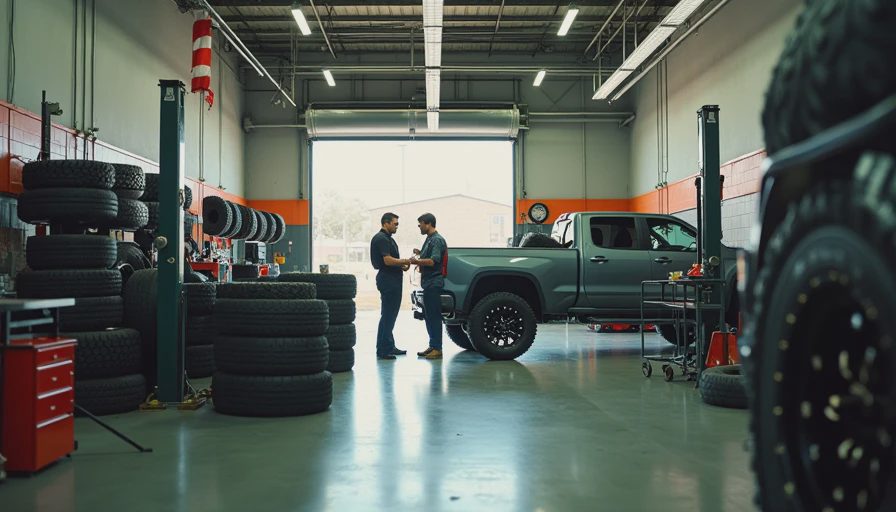
Installation details people skip
New rubber does not cure worn steering. Before mounting the best truck mud tires, inspect ball joints, tie-rod ends, wheel bearings, shocks, and control-arm bushings. A mud tire has heavier rotating mass, so a loose component that was barely noticeable with stock tires can become a violent shake at 55 mph.
Balance all four tires and request a road-force balance if the shop has the machine. Align the truck after installation, especially if the suspension was lifted. Set toe correctly; excessive toe-out can destroy the outer tread quickly. Torque the lug nuts with a calibrated wrench, then recheck them after roughly 50 to 100 miles. The exact torque belongs to the truck, not the tire, so use the owner's manual or factory service information.
Break the tires in on pavement before testing them in deep mud. Check pressure cold, inspect for uneven shoulder wear, and rotate according to the wear pattern rather than blindly following a calendar. Mud packed inside a wheel can also create a balance problem after a trail run. Knock it out before blaming the alignment.
The purchase decision I would make
For a weekend trail truck that still drives to work, I would choose a 33-inch BFGoodrich KM3, Falken M/T01, or Nitto Trail Grappler in the correct load range, provided the suspension and gearing can support it. For a dedicated mud truck, the Mickey Thompson Baja Boss earns consideration because its aggressive construction is useful where sharp rocks and deep ruts are normal.
For a daily-driven pickup that sees occasional mud, spend the money on an excellent all-terrain and a proper recovery kit instead. A winch, rated shackles, traction boards, and an air compressor solve more real problems than another inch of tread depth. If you do buy the best truck mud tires, budget for alignment, balancing, rotations, and the fuel mileage hit.
I once assumed a customer's truck needed a more aggressive tire because it kept getting stuck on a wet access road. I checked. The rear differential was open, the tires were overinflated, and the driver was entering the hill too fast. We changed the pressure, adjusted the approach, and installed a limited-slip unit later. The truck stopped digging holes before it needed a more expensive tire.
Choose the rubber that matches the dirt, the payload, and the miles between your driveway and the trailhead. Then crawl under the truck with a light before you leave. The bolt doesn't lie.


No letters yet — pray write the first.